LA Register Folds: Another Nail in Print’s Coffin?

Standard

LARegisterLogo

It’s no surprise to see the news today that the LA Register newspaper is folding and giving up on its grand experiment in print journalism. All of us who love newspapers had great hopes but knew that this was probably an ill-fated effort to restore an antiquated concept of actually reading your news in a printed format delivered to your door.

The editors, Aaron Kushner and Eric Spitz, told readers the 5-month experiment ended with the Sept. 23 edition. They noted that readers “tell us regularly how much you enjoy our approach to newspapering. Unfortunately, not enough readers took us up on our offering…”

They notified the staff last night via email from a “Do not reply” email address, as noted by Asher Klein on Twitter. It seems a little tacky for a news operation to use email – much less a Do Not Reply address – for such personally devastating news to its staff. Moreover, Asher tweeted today he still doesn’t know what this means for his future employment with Freedom Communications, which owns the Register and other papers.

The LA Times reports that the memo to the staff said: “There will be some staff changes with our content team as part of the changes in Los Angeles. For those that will be leaving, we say thank you. We are most grateful for their service to the community.”

Freedom Communications said it is transitioning Long Beach and Orange County subscribers to their Long Beach and OC editions, which it owns. In his memo to the staff, which was quoted in the LA Times, Kushner said the company will now focus on core markets in Orange County, Riverside and San Bernardino counties, where the company has decades-long and “deep relationships with subscribers and advertisers.”

While the LA Register’s demise is another nail in the coffin of print journalism, it should also be noted that the owners never fully staffed the LA Register to cover LA. Instead, editors re-purposed content created by reporters for their other papers – a common practice with all papers with joint ownership.

Newspapers that do this profitably and successfully also have a large enough staff to produce some significant share of content that is unique to the geographic region the papers serve. Clearly, covering the sprawling metropolis of LA requires quite a few reporters, and the Register simply didn’t have that many.

In addition, the LA Register never fully evolved as a separate edition. Even the IP address still has the OC Register in it: http://epaper.ocregister.com/Olive/ODE/LARegister/?elq=863a186506ca4802aa6f27cf7eb6e5a8&elqCampaignId=9129

All in all, it was a valiant but misguided and underfunded effort to rekindle an interest in newspapers at a time when we increasingly rely on mobile devices and other means to get our news. We’re sorry to see it go. We hate to see more reporters who may be out of work. But its demise seemed inevitable.

IN ADDITION:

Money has been a problem for Freedom. Just yesterday, it announced it had sold the Orange County Register’s Santa Ana headquarters to developer Michael Harrah for $27 million. The OC Register announced that Freedom will lease back the 175,000-square-foot building, located on Grand Avenue just off Interstate 5, for 20 years. Freedom still owns the adjacent property that houses the company’s printing presses. According to the Register, Kushner said Freedom decided to sell the company’s headquarters “to further strengthen our balance sheet.”

Top 5 Reasons for Re-branding

Standard

isissoftcardBy taking responsibility for the beheading of two American journalists, the radical group now identified as ISIS by most in the media has turned the name of an Egyptian goddess into a dirty word. Unfortunately, several companies also have the same name.

CNBC’s Jane Wells tackled this topic in her report today. She reported that Isis Mobile Wallet already changed its name to Softcard, and is now benefitting from the publicity surrounding this quick re-brand in response to fallout from the radical organization.

Jane reported that Isis Pharmaceuticals discussed changing its name as well. However, the company decided it could afford to keep its 25-year old name because it’s mostly a B2B business as opposed to retail. On a more personal level, one father who named his daughter Isis told Jane that his co-workers had teased him that he might lose his head if he grounds his 3 year old.

For anyone with Isis in their name, this is no laughing matter. The name by which you are known, whether you are a company or a person, says a lot about you. That is why branding is considered such an important part of any company’s formation and growth. Having the same or a similar name and/or a logo that is similar to another better-known company can sabotage the development of a company’s brand.

One of our clients, for instance, was originally known as the Research and Education Institute or REI. This is, of course, the name of a much larger and better-known company that sells sporting goods. Its leaders at the time changed the name to LA BioMed.

Another client that appealed to environmentalists was concerned that its logo looked too much like BP, the oil company’s, logo. This became an issue after BP took responsibility for one of the largest oil spills in history. The logo was similar, but not the same, and still became a cause for concern. Moreover, the financial considerations surrounding rebranding prevented the development of a new brand.

Branding and re-branding can be an expensive process if done right. The successful development of a new or refreshed brand takes time. With a new company, once the brand is developed, the remaining costs entail getting it out to potential customers in a memorable way.

With re-branding, though, the challenge is getting the staff and all other stakeholders to adopt and use the new brand. Successful re-branding also requires everything associated with the brand being updated with the new images and/or name—from social media to signage. Invariably, something slips through the cracks, and the old brand will continue to pop up on old materials and in other unforeseen places.

Re-branding can be essential to the success and growth of companies whose brands no longer fit what they do or that have become tarnished by forces beyond their control, such as the use of ISIS to describe a radical group, or by their own actions. So when do you know when you need to re-brand?

Here’s our list of the Top Five Reasons for Re-branding:

  1. The brand is tarnished or taken over by others: This is the ISIS scenario and should be considered when your brand is damaged beyond repair. But don’t react too quickly. Already, President Obama is trying to get everyone to call the radicals ISIL instead of ISIS. If he’s successful, the current stain on the name may be erased. The client with the logo that looked like BP merely awaited the shift in attention from BP and avoided the cost of re-branding. When you get that letter warning you that you’re infringing on another’s trademark, though, it is certainly time to consider re-branding.
  2. New audience: If you are looking to reach a new audience, it may be time to re-brand. The Juvenile Diabetes Research Foundation, for instance, is trying to move beyond just appealing to parents of kids with diabetes. It’s also trying to acknowledge that Type 1, or juvenile, diabetes strikes adults as well as children. So it’s re-branded as JDRF, and it’s working on rebranding juvenile diabetes as ‘T1’ to appeal to today’s audiences. McDonalds is another example. It increasingly uses ‘MickeyD’s’ to appeal to a younger market.
  3. New line of business or a new market: Depending on the name, this can be a clear-cut time for re-branding. One of our clients is in the midst of changing what it does and is currently working on an entirely new name and brand. It likely will keep some components of its existing brand (as JDRF did in keeping its initials) to keep current customers informed, but it will add to that brand to reflect its expanded services. Or you may still be using a name that no longer fits because you’ve expanded beyond the geographical location associated with the company name.
  4. Mergers, acquisitions and growth: In the case of mergers and acquisitions, the new company often will keep the name of the stronger brand. For instance, Bank of America remained Bank of America even after it was acquired by another, lesser-known bank. But sometimes new names will emerge to reflect the combined operations, such as PricewaterhouseCoopers. Law firms may change their names to reflect the addition of new partners. At some point, though, the list of partners gets too long, and they have to make choices. One of our clients, Wilmer Cutler Pickering Hale and Dorr LLP, re-branded as WilmerHale, a much shorter and easier name to use that still reflects its roots.
  5. Lack of differentiation in the market: When sales are flat or falling, it may be time to re-brand. An assessment to determine the cause of the market failure is essential. Is the problem the product, the brand or both? If the problem is the brand, then a successful re-branding and market re-positioning should help improve sales.

Are press releases still relevant?

Standard

chart 1

The answer from a new Business Wire survey is a resounding yes. Its survey of 300 journalists found 9 out of 10 had used a press release in the preceding week. While there is increasing focus on social media to speak to a wide constituency, only 1 percent of the journalists surveyed by Business Wire said they wanted to be pitched through social channels; 22 percent preferred news releases for pitching.

It’s hard to generate interest in a topic in 140 characters or less. A well-written, concise press release can make the difference in attracting reporters’ attention before they hit the delete button on their computer or mobile device.

In addition, 70 percent of respondents said their jobs would be harder without press releases. Providing accurate and relevant background in a press release – which couldn’t be done in a short social media post — helps ensure the resulting story is more accurate. That is a key challenge today with reporters juggling so many demands for content for the web and print editions. At many publications, journalists are given little time to research and check the facts in their stories. As a result, providing context, background and/or explanations for technical terms and other complex topics are a big help for most reporters.

Of course, many reporters will tell you they don’t wish to be pitched at all. This is understandable given the large number of pitches they receive on a daily basis that have nothing to do with the subject matter they cover. Ensuring the pitches are on target and having pre-existing relationships with reporters make a big difference in the success of suggesting story topics to journalists.

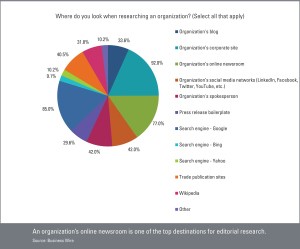
While they don’t welcome pitches through social media, 74 percent of the journalists Business Wire surveyed said they do rely primarily on social channels for researching topics. Providing strong content through social media will make your social channels relevant to journalists.

Of course, social media is about much more than journalists. It’s really aimed at building a community, and journalists aren’t necessarily a preferred demographic of that community. But it’s clear that social media helps with media outreach as well. Moreover, websites and online newsrooms remain an important source of information for journalists.

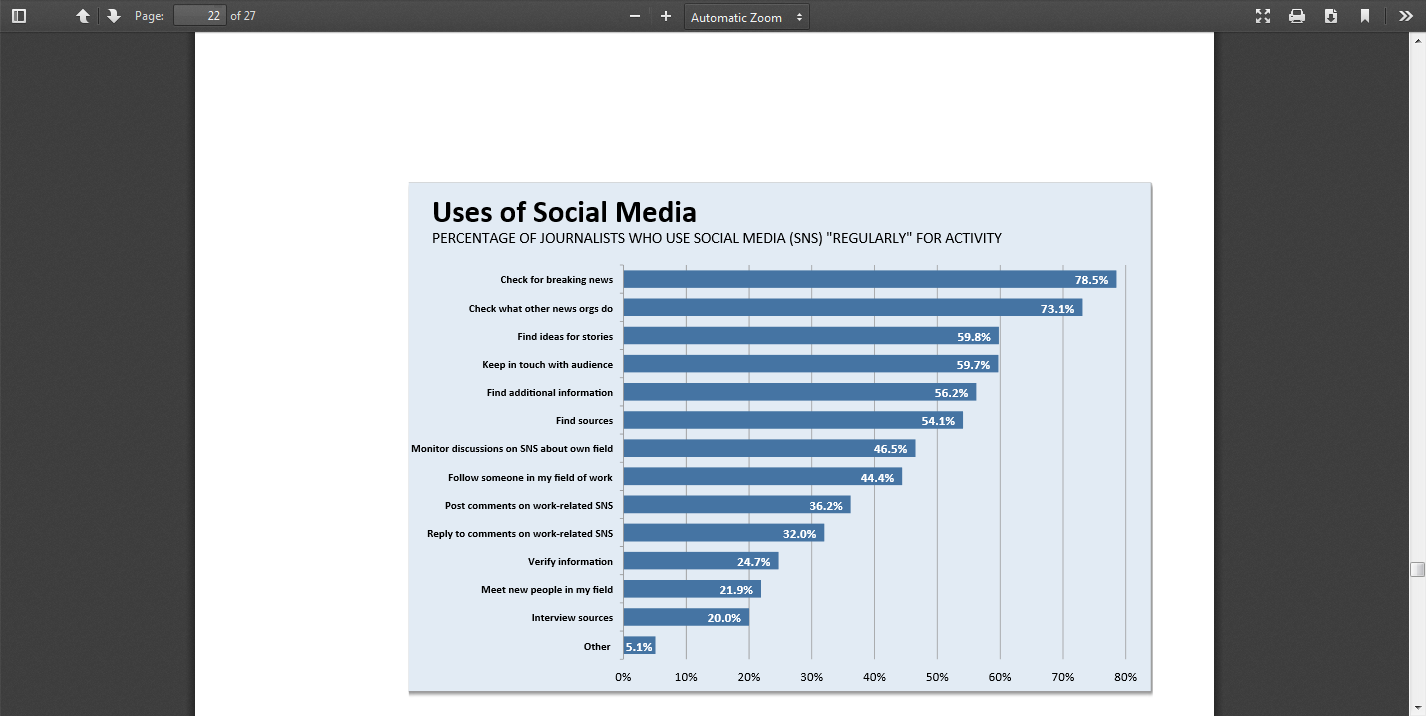
Business Wire is a service for distributing press releases, so some may question its findings in support of continued usage of the press release. But the findings jibe with other surveys, including an Indiana University survey earlier this year that found journalists used social media to stay informed and monitor competition: About three-fourths used social media to check breaking news and see what other news organizations were doing.

Given that this is how they are using social media, it is perhaps no surprise to find that nearly 60 percent said they did use social media to identify story ideas, interact with audiences and/or find additional information about a topic. Breaking news and the competitors’ focus on a topic will always drive coverage; reporters always look to the competition to be sure they have covered what’s breaking and hit all the key points in a story. The challenge is getting the media’s attention in the first place. For that, a well-written press release, a targeted pitch and/or a well-placed phone call with follow-up information continue to be vital to getting the media’s attention.

chart 2


At the time they replied, 90 percent of journalists surveyed had used a press release in the previous week, and 53 percent said they used newswire content one or more times a day.

FIVE TIPS FOR A POWERFUL PRESENTATION

Standard

With studies showing the fear of public speaking ranks up there with the fear of death, speakers are often advised to picture their audience naked.

Don’t worry. You don’t have to strip the audience bare to communicate effectively. But you do need to become intimately familiar with who your audience will be before deciding whether to give a speech or what to say.

Once you know your audience, you can best determine the goals for your presentation, the messages that will interest that audience and the best time and the best platform for reaching that audience.

harvey

  1. UNDERSTAND YOUR AUDIENCE

To get a clear picture of the audience, visualize someone you know in the audience who is typical of the group. Or if you don’t know anyone who fits that description, create that person by asking yourself questions such as: How old is this person? What does this person do for a living? If you were sitting across the dinner table from this person, how would you communicate the messages you wish to convey?

A key question: Would this person even be interested in a speech? Or might he or she prefer a roundtable discussion, a question-and-answer session or some other format?

For instance, when a client asked us to speak to a group upset about upcoming changes, we decided a roundtable discussion would be more effective than a speech. The audience members expressed their concerns. We listed suggested strategies and got a show of hands as to which ones were priorities. In this way, the presentation accomplished its goal: We identified the audience’s chief concerns and collectively decided the best solutions.

  1. SET YOUR GOALS

All communications should have a clear goal. It may be to persuade, convince or enlist support. Whatever the goal for that group, virtually all communication should also seek to inform and entertain. Once the goal is established, it’s much easier to structure a presentation to accomplish that goal while also informing and entertaining the audience.

For instance, the goal for a recent presentation was to determine communication strategies for increasing immunization rates among minority groups. Knowing the audience – an immunization advocacy association – had little knowledge of effective communication techniques, we spoke for about 15 minutes to educate the group on communication techniques, using cartoons and funny examples to inform, entertain and engage the group.

Then we asked a series of questions that drew the group’s input on the best messages for improving immunization rates and strategies for delivering those messages. At the end of the session, we had crafted an outline for a communications program.

  1. CRAFT YOUR MESSAGE

Once you’ve established your goals, determine your central thesis or title. Then decide on your three or four major points. The audience can’t absorb many more than that. Each main point should have between two to four substantiating points. These are data, anecdotes and examples to support your main point.

At this point, you may be tempted to create a PowerPoint. That’s fine if it helps construct your speech. But please consider not showing it to the audience while you’re speaking. A PowerPoint will turn you into a reader (instead of a speaker). It also takes the audience’s eyes and minds off you.

Instead, print out the PowerPoint and hand it out afterward. Or, if you must show something, use your PowerPoint to illustrate your points and entertain by showing the audience a cartoon, photo, video clip or other illustration.

Also remember the golden rule of public speaking: Tell the audience what you’re going to tell them, tell them and then tell the audience what you told them. Briefly summarize your presentation at the outset, deliver your messages and then summarize briefly at the end. Don’t forget to leave the audience with the action you wish it to take.

  1. SELECT YOUR SETTING

Finally, try to control when and where you’ll be delivering your presentation. If it’s a conference or day-long meeting of some sort, try to avoid the after-lunch and end-of-the-day slots when the audience is ready for a nap. Check the room ahead of time to be sure the sound system works. Eschew the podium, if possible, to actively engage the audience.

When you have no choice on your timing and location, look for ways to liven it up. At an end-of-the-day presentation at an association’s annual conference, the state lottery was among the topics to be discussed. So we distributed scratch-off lottery tickets to members of the audience who asked questions. No one won, but we had fun seeing if they did.

  1. HAVE FUN!

Above all else, be yourself. Have fun with whatever format and message you choose because if you’re not having fun, your audience won’t either.

# # # #


The “Gig Economy”

Standard

small-business


This is a term that’s gaining popularity as our nation shifts from the traditional 40-hour, one employer, office-driven workforce to a more entrepreneurial and independent workforce. Rather than jumping into the car for a long commute to an office, America’s workforce is increasingly opting for a more mobile and, arguably more creative and efficient, way to work.

As Sara Horowitz, the founder and executive director of Freelancers Union, a national labor group representing the new workforce, points out in an op-ed in the LA Times today, the “Era of Big Work” is ending:

“Freelancers, independent contractors and temp workers are on their way to making up the majority of the U.S. labor force. They number 42 million, or one-third of all workers in the nation. That figure is expected to rise to 40% — some 60 million people — by the end of the decade.”

She notes a number of forces that led to this shift, including more mobile technologies that make it possible for us to work from almost anywhere and the Great Recession, which sent former office workers off in pursuit of new ways to work. She also cites the millennials’ greater desire to balance work and life than their Baby Boomer parents or grandparents, as the case may be.

Sara’s article focuses on the benefits to workers. We also see big benefits for the businesses that rely on these independent workers. In our case, our clients get more personalized service from more seasoned professionals at a more affordable price because we avoid the overhead of the “Big Workplace.”

We are a network of experienced communications professionals who would command much higher prices in a large firm with all its overhead of high-end offices, marketing, administration, etc. In public relations, these firms generally profit by using their senior staff to sell their services and using junior staff to deliver the services.

By working independently, we avoid the overhead. We provide personalized services from senior staff, rather than junior staff members, because we don’t have any. Our marketing costs are minimal because we rely on word-of-mouth from satisfied clients and colleagues who recommend us to others. This, of course, means we have to provide excellent services.

In her op-ed, Sara declares: “The Era of Big Work is indeed over, and good riddance. Welcome to the Era of Meaningful Independence.” We would also say: “Welcome to the Era of More Experienced, Efficient and Effective Services.”

South Beach Doc Speaks

Standard

Here’s a great opportunity offered by one of our clients for health care professionals to hear from Dr. Arthur Agatston, the developer of the South Beach Diet and the Agatston Score:

doctor pdf

Why Do Journalists Make Good PR People?

Standard

AA040013

A prospective client recently asked why we pride ourselves on being former journalists. Our network includes two former journalists, both of whom left the business several years ago and have spent the intervening years mastering the skills of communicating beyond the pages of a newspaper. The experience we have gained since leaving the news business is invaluable. Still, we see reasons to be proud about our background as journalists. Among these are the following:


  • Former journalists are the best-trained writers: As journalists, we wrote hundreds of stories every year and learned how to improve our writing from the excellent editing we received from many great editors. Journalists don’t fully appreciate the training they get with the many layers of editors that review every bit of content they produce. People who have never been in journalism cannot replicate that experience and training.


  • Former journalists know how to make complex topics interesting: Clients and other PR firms have valued our ability to take complex topics and turn them into understandable content for publications, infographics, videos, press releases, websites or blog posts. We are great at developing messages because we know how to research and synthesize data to develop and support each message point.


  • Former journalists make a client’s job easier: We have had clients comment on how they routinely received content from other firms that fell short of what they needed and had spelling and grammatical errors. They were frustrated that they had to spend hours of their time fixing the work of well-compensated consultants, and they appreciated that we provided them with content that required little work on their part. Our job as consultants is to make the client’s job easier. Consultants who aren’t skilled writers do just the opposite.


  • Former journalists are a better investment for content creation: Years of working on extremely tight daily newspaper deadlines make former journalists better investments. They are faster and more efficient in their work. While others may devote half a day or more to one press release, most journalists can turn out that press release in a couple of hours, at most. Their news judgment and skills also will serve the client well in helping to determine what might interest the media. They won’t waste a client’s time and money researching information that is unhelpful. They know how to focus their search for what they need and how to quickly turn it into usable content.


  • Former journalists are natural storytellers: As numerous studies have shown, facts only tell. Stories sell. Former journalists are storytellers, and they know how to tell a client’s story in a memorable and meaningful fashion. Using a story to convey the facts about a client’s product, services or organization is the best way to ensure the audience gets the facts the client wishes conveyed.


These are just a few of the benefits of having a background in journalism. We’re sure other former journalists can name even more. Please let us know!


Diversity in the Media

Standard

The racial tensions in Ferguson highlight once again the need for diversity in the media, and an excellent post by Gabe Rosenberg shows that newsrooms have made few advances in hiring a more diverse workforce.

As the Pew Research Center has shown, the percentage of minority (a word that really no longer fits in California where “minorities” are now the majority) journalists in America’s newsrooms has stayed at about 12% since 1994.

Having worked in newsrooms for much of our professional lives, we can attest to the concerted efforts to hire journalists who are not all white and male. But it’s not been an easy path to create a more diverse workforce in an industry that still cherishes some hidebound traditions and points of view.

As some of the early women in newsrooms can attest, sexism in the workplace was rampant. Some older male editors were known to award plum assignments to females who kept them company after hours. A few male news sources sometimes did the same with juicy tidbits of news. (One boss once suggested that we could get a job we wanted if we would come sit under his desk.)

As the number of women in the workforce grew and women moved into management, the sexist comments waned. Diversity training proliferated, and actions were taken against people who violated workplace rules.

Even though their percentage plateaued at about 35% in the late 1990s, they have found themselves more often on equal footing with male reporters. (While we know several very strong female editors, especially at The Sacramento Bee, women in top management still lag behind men in management positions.)

News organizations actively recruit “minorities.” But the chances for advancement may not be clear to job applicants when they’re interviewing with a primarily white leadership team. Moreover, the desire to enter journalism is clearly on the wane among most savvy college graduates because of the uncertain future of the enterprise. More outreach, as Lam Thuy Vo recommends on her blog, is clearly the answer.

But even more important will be strengthening journalism to ensure that newsrooms are a place where the most talented contenders will want to work and will feel their work will have meaning.  


15663023-mmmain

Selling Your Brand

Standard

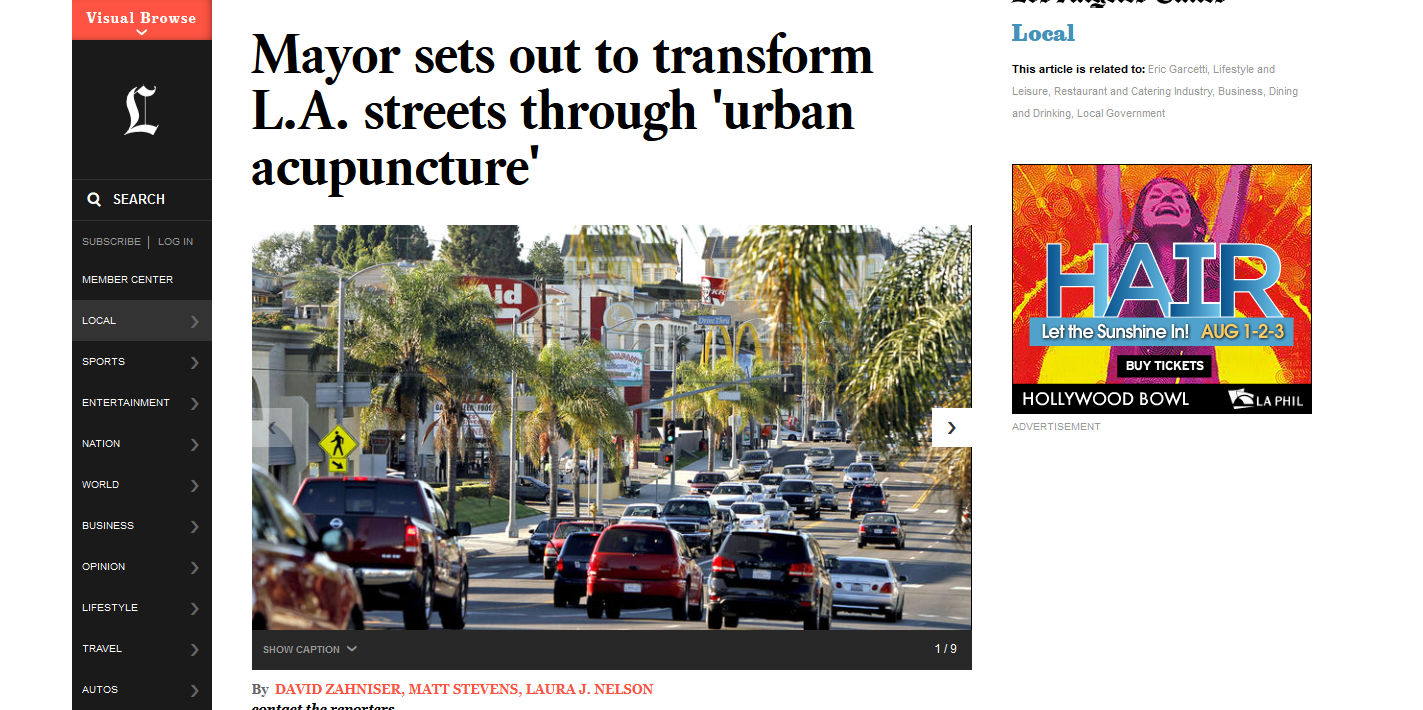
Blog post 6 imageOn this morning’s highly rated KTLA-TV newscast, the anchors spent a couple of minutes ridiculing the term Mayor Eric Garcetti used for his “Great Streets” program. He called it “urban acupuncture,” and that became the headline in the LA Times, rather than the “Great Streets” brand. Unfortunately for the mayor, the news anchors seemed to spend more time ridiculing the name than explaining the plan.

Successfully naming, or “branding,” a program is one of the biggest communications challenges. Be too creative and no one will understand it or, worse, they’ll ridicule it. If you’re not creative enough, the name won’t be memorable. How do you find the brand that is just right? And once you’ve established the brand, how do you make sure it gets used?

The issue here is that the mayor may have undermined his own brand by using a more creative term than the “Great Streets” brand. Developing messaging to ensure the brand is used successfully is essential. Too often, we see an individual’s random comments transformed into headlines that make them cringe. Or even worse, undermine their very efforts.

Messaging and sticking to that messaging helps avoid these headlines. Asking yourself if you would want to see those words or that description in print or as the sole soundbite on the TV news will help avoid headlines that make you cringe.

Before any interview with the media, sitting down in a quiet place, thinking about what will be said and how it will appear to the people you wish to reach and only then writing down what you would like the headline to be will be very helpful in producing the headline and the content you want.

No doubt, the mayor and/or his staff had done all of this. He has a first-rate communications team, and he is a skilled communicator. Ridicule on the Sunday morning KTLA-TV newscast is seen by a very small audience because so few people watch TV news on the weekend mornings.

We look forward to seeing if the mayor and his team choose to stick with “urban acupuncture” or not.

Acupuncture, once ridiculed as medical hucksterism, has gained respectability as it’s been shown to be extremely effective with certain conditions. The notion that a targeted urban renewal program could perform as acupuncture does and send healing throughout the “body” of the City of Los Angeles is an intriguing one. As the Sunday morning newscast shows, this creative term for an old-fashioned urban renewal program will have to get past the news media’s filters to become a meaningful description for “Great Streets.”

It’s Alive!

Image

A new infographic from Burrelles Luce, the media monitoring service, shows newspapers aren’t dead yet. Circulation in the nation’s top 25 newspapers has grown an average of 25% over the last five years.

More than half of Americans are still reading their newspapers in print, and some of the country’s savviest investors are buying newspapers. So, the argument goes, if Warren Buffett and Jeff Bezos think print is a good investment, it must be a thriving industry.

Not sure we fully agree. While newspapers have created web presences, most still haven’t figured out how to make money online. And many of their Internet offerings leave a lot to be desired in terms of the users’ experience.

Still, we believe newspapers remain an important part of most communications efforts. Content is king as they say. And newspapers still have more staff and greater skills to produce written content than anyone else. Opinion leaders still read them. Their online content gets recirculated through emails, texts, social media and more. And so many of the other outlets – from television to bloggers – look to newspapers for story ideas and content for commentary.